
Peer-reviewed articles:
Epistemology of Folk-Lore | In: Social Epistemology (2025).
Abstract: Testimony is a central concept in the epistemological debate on knowledge and learning. It is therefore surprising that testimony plays a minor role in the empirical literature on cultural learning. This raises the question of whether our approach to knowledge in epistemology might be missing out on some things when applied to cultural knowledge and its transmission. By taking the semantic component of knowledge in the compound folk-lore at face value, we aim to explore whether the concept of folklore could potentially help out here. Three persistent puzzles concerning folklore and its study are discussed to this end: (1) What is the ontological status of folkloric objects of study? (2) How shall one safeguard folkloric objects, depending on different possible answers to the ontological question? (3) How could we distinguish fake-lore, i.e. folklore that is merely seemingly representative of epistemic groups, from more representative folklore?
Should We Embrace Impossible Worlds Due to the Flaws of Normal Modal Logic? | In: Logica Universalis 18: 301–314 (2024).
Abstract: Some philosophers advance the claim that the phenomena of logical omniscience and of the indiscernibility of metaphysical statements, which arise in (certain) interpretations of normal modal logic, provide strong reasons in favour of impossible world approaches. These two specific lines of argument will be presented and discussed in this paper. Contrary to the recent much-held view that the characteristics of these two phenomena provide us with strong reasons to adopt impossible world approaches, the view defended here is that no such ‘knock-down arguments’ do emanate on those grounds. This is not to rule out that there cannot be any other good reasons for assuming impossible world semantics. However, the discussion of a further argument for impossible worlds will suggest that different attempts to argue for them likely present intertwined problems.
Possible Arguments against Impossible Worlds in Wittgenstein’s Tractatus | Forthcoming in: South American Journal of Logic.
Abstract: At first glance, impossible world semantics appear to be useful adaptations of normal modal logic. Proponents of impossible worlds argue, e.g., that in the context of metaphysical disagreement, impossible worlds would provide a key to modelling the respective dispute situation. The same philosophers also argue that we need impossible worlds to model what they consider to be the conceivability of logical impossibilities. With the help of Wittgenstein’s early philosophy, or, better said, with what I believe to be a visualisation of his ideas on nesting models for possibility, I develop some thoughts on the likely shared weaknesses of such arguments for non-normal world approaches. Said goes hand in hand with the supplementary proposal of rethinking our conventional nesting models for possibility.
Talks (selection):
- “Epistemology of Folk-Lore” at: Minds and Worlds – 16th Conference of the Italian Society for Analytic Philosophy, 28.08.2025, Turin, Italy.
- “(Rational) Deference to Groups? The Case of Folk-Lore“. At: The 18th Cologne Summer School in Philosophy (on Applied Epistemology, special guest: Alex Worsnip), 22.07.2025.
- “Genuine problems and ‘merely’ possible worlds” [GE: Echte Probleme und ‘bloß’ mögliche Welten]. At: Borderfictions – aesthetics and pragmatics of political borders, 30.11.2024, University of Cologne.
- “Should We Embrace Impossible Worlds?“. At: Springer Mathematics & Statistics Webinars, 2024, February 14. Introduction: Jasmin Özel (University of Siegen). Moderation: Ahti-Veikko Pietarinen (Hong Kong Baptist University), doi.org/10.52843/cassyni.ddvv89.
- „Impossible Worlds? ‘Let us not be bewitched’.” At: First South American Logic Meeting (SALOME1), 12-15.01.2024, UNSAAC, Cuzco, Perú.
- “On the independence of fictional speech and the constraints of simulation” [GE: Über die Freiheit fiktionaler Rede und die Gebundenheit von Simulation]. At: Fiktion und Simulation: Wie entsteht und was bedeutet ‚virtuelle Realität‘?, High-Performance Computing Center Stuttgart, 13./14.12.22.
Articles (under review/in progress):
Unpacking Mystery Boxes: The Logical Substructure of Prima Facie Conception
↳ Abstract: Prima facie conception can appear mysterious. Having a prima facie grasp of something means being ‘on the edge’ of conceiving. But it seems that often there is no way for us to know, if what our intuitions tell us to prima facie conceive is actually conceivable, i.e. conceivable under ideal rational reflection. We propose a novel account of prima facie conception: On the basis of working hypotheses concerning the logical interactions of conception, imagination and prima facie conception, we isolate different subtypes of what we call general prima facie conception. With these tools, we explore (what seems to be) the deeper logical substructure of prima facie conception. This could pave the way to an understanding of different reasons for different intuitions (for instance, concerning conditionals with impossible antecedents). Importantly, we do not make use of impossible worlds throughout the inquiry. The results arguably also offer the opportunity for rigour in other matters.
Mathematical Folklore, or: Shared Cognition in Mathematics
↳ Abstract: There is an ongoing trend towards shared cognition – or, at least, towards shared authorship – in mathematics. This trend is diametrically opposed to what looks like a lasting individualist focus in the epistemology of mathematics. For there seems to be a trend towards wanting to understand central topics in (the philosophy of) mathematics and (in the philosophy of) its practice primarily at the level of individual, cognitive agents. There is no doubt that the individual-level-approach (ILA) is a good and valuable approach. However, the social, cooperative nature of mathematics and mathematical practice is arguably often overlooked in going down (exclusively) the ILA-road. This essay attempts to contribute to this often neglected dimension of mathematics (at least in the philosophy of mathematics, perhaps less so in the considerations of mathematicians regarding their own field). The present work is an attempt to consider not only the ILA, but also a group-level-approach (GLA) as a promising approach in the philosophy of mathematics.
Is there a moral value to suspended judgment?
↳ Abstract: It can be argued that suspending judgment about p, i.e. holding p to be neither true nor false – given a certain relation of the mind to the world – is rational and even the preferable alternative amongst the three possible ways to go (1. holding p to be true, 2. holding p to be false, 3. suspending judgment about p). Let q be a moral proposition. Now, are there cases in which withholding our judgment about q has a moral value, is at its ‘moral best’, so to speak? And, if so, how does suspended judgment at its epistemic best relate to suspended judgment at its moral best?
Distinguishing the Metaphor of Possible Worlds from the Concept of Possible Worlds
↳ Abstract: Possible worlds are an indispensable tool in contemporary philosophy. There is talk of them everywhere. However, there also seems to be a lot of confusion about what is meant by the expression ‘possible worlds’. For example, it is important to distinguish whether or not one is referring specifically to corresponding formal semantics when one uses the expression ‘possible worlds’. This paper explores the question of whether there is a substantial conceptual link between what perhaps is best described as post-Kripke-possible-world-concept and pre-Kripke-possible-worlds-talk.
PhD (ongoing):
Version 11.02.2026:
Understanding Fictional Discourse – From the Logic of Our Minds to its Power in the Streets
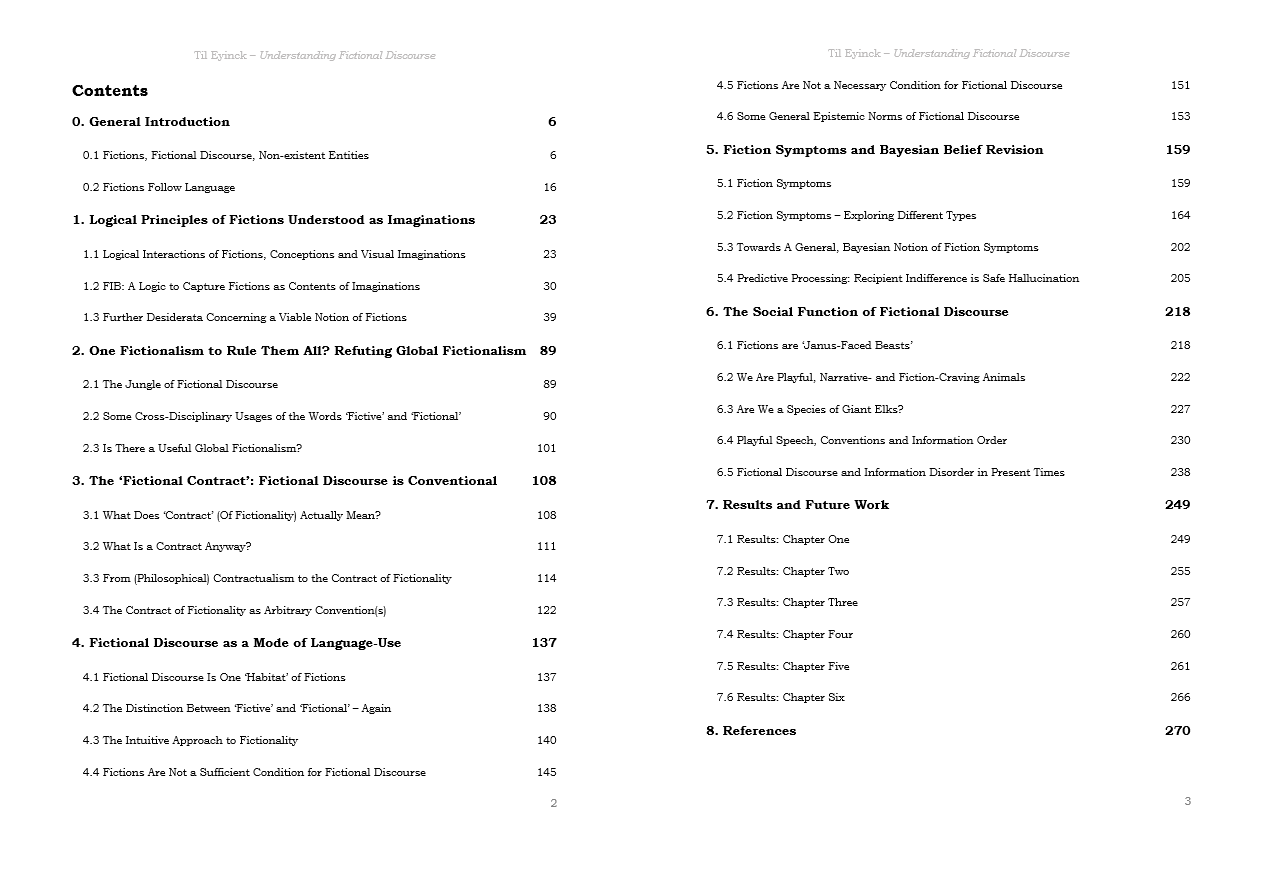
Doctoral subject: Philosophy. First supervisor: Prof. Dr. Sven Bernecker (CONCEPT – Cologne Center for Contemporary Epistemology and the Kantian Tradition).
Teaching:
I taught extensively at university over the past few years. You can find a brief overview here.
 Til Eyinck